Tax Planning Strategies: Avoidance Basics, Freelancer Tips, Deferrals, and Expert Standards
Taxes are one of those things nobody really loves talking about, but getting them right can put thousands of dollars back in your pocket every year. The difference between paying the absolute minimum you legally owe and accidentally overpaying often comes down to smart tax planning done well before April rolls around.
In 2025, the rules haven’t changed as dramatically as they did a few years ago, but inflation adjustments, new retirement contribution limits, and a few lingering COVID-era provisions still create fresh opportunities. Whether you’re a W-2 employee, a side-hustling freelancer, or running your own company, the core ideas remain the same: understand what’s deductible, take advantage of credits, defer income when it makes sense, and never, ever cross the line into evasion.
Let’s walk through the essentials so you can finish 2025 with a smaller tax bill and zero surprises.
Tax Planning vs. Tax Preparation: Why the Difference Matters
Most people use the words “tax planning” and “tax preparation” interchangeably, but they’re completely different animals.
Tax preparation is what happens in March and April: gathering your W-2s, 1099s, receipts, and charity acknowledgments, then filling out the forms (or handing everything to your accountant) so the return gets filed on time. It’s backward-looking and compliance-driven.
Tax planning is forward-looking. It’s the deliberate set of choices you make throughout the year to lower your taxable income or move it into a year where your marginal rate will be lower. Good planning starts in January (or better yet, in December of the prior year) and never really stops.
Think of preparation as paying the bill you already ran up. Planning is deciding not to order the extra appetizer, so the bill is smaller in the first place.
The Line Between Legal Tax Avoidance and Illegal Evasion
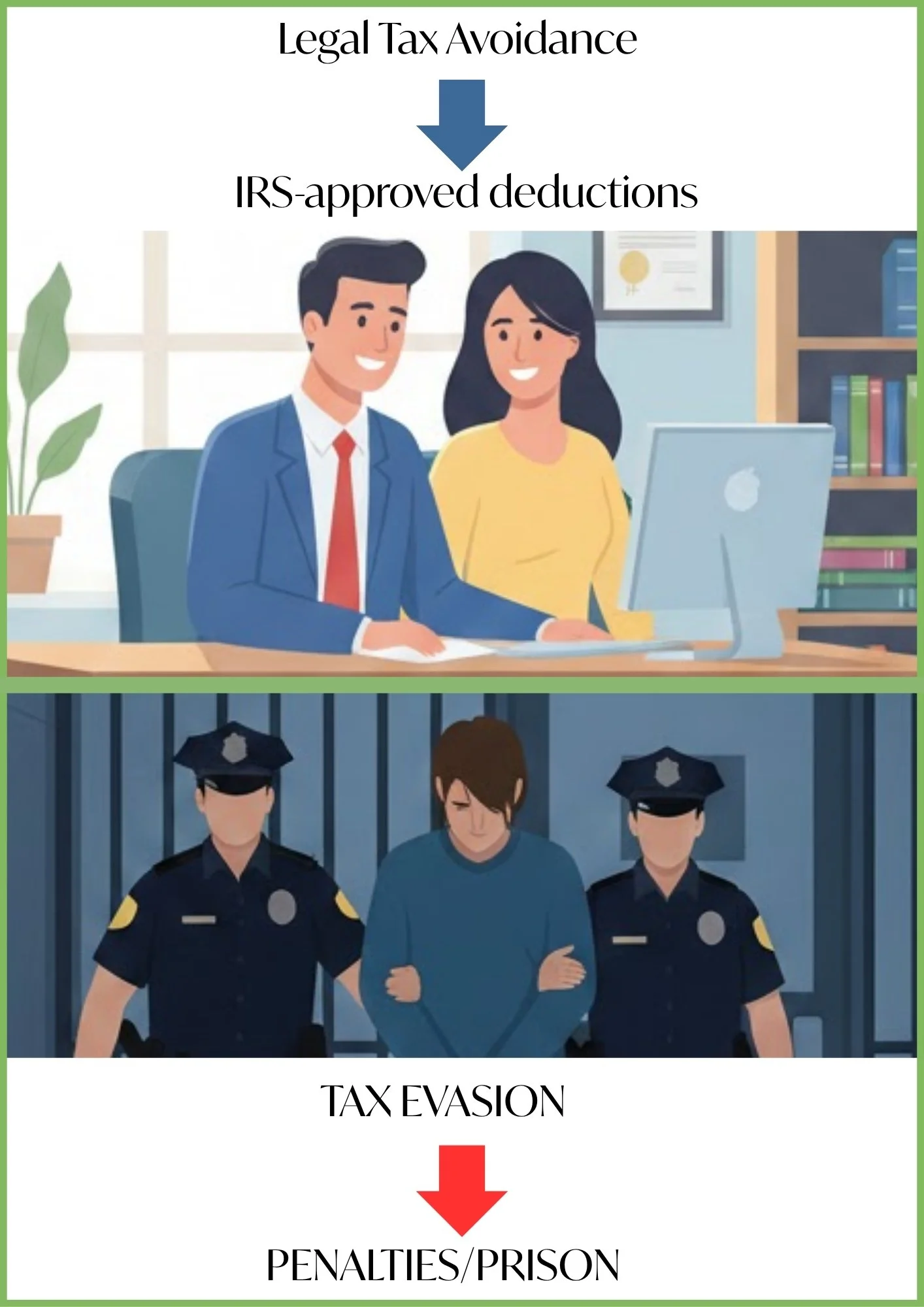
Everyone hates paying more tax than they have to, and that’s perfectly fine. The IRS itself says you have the legal right to arrange your affairs to pay the least amount allowed under the law. That’s tax avoidance, and it’s 100% encouraged.
Tax evasion, on the other hand, is deliberately lying, hiding income, inflating deductions, or otherwise breaking the law. The difference is night and day, and the penalties for evasion can include prison time.
Some of the simplest and most effective avoidance moves in 2025 are still the classics:
Maxing out pre-tax retirement accounts (401(k), traditional IRA, SEP-IRA, Solo 401(k))
Bunching charitable contributions or medical expenses in alternating years to cross the deduction thresholds
Using Health Savings Accounts (HSAs) – triple tax-advantaged and still one of the best deals going
Taking advantage of the increased standard deduction ($15,000 single / $30,000 married filing jointly after inflation adjustments)
Harvesting capital losses to offset gains
If you want a deeper dive into everyday legal strategies, here’s a full post on breaking down the basics of tax avoidance.
5 Things Tax Planning Experts Really Want You to Know in 2025
I asked several CPAs what they wish every client understood when walking in the door. Here’s the short list that came up again and again:
Retirement contributions are still the single biggest “legal tax dodge” for most people. In 2025, you can put $24,000 into a 401(k) plus another $7,500 if you’re 50 or over. Self-employed? A Solo 401(k) or SEP-IRA can let you shelter 20% or more of your net business income.
Quarterly estimated payments aren’t optional for freelancers and business owners. Miss them, and you’ll owe underpayment penalties even if you pay everything on April 15th.
The standard deduction is so high now that itemizing only makes sense if you have a big mortgage interest, massive charitable giving, or unusually high state taxes/medical bills.
Deferring income can be powerful, but only if you’ll actually be in a lower bracket later. For most people, accelerating deductions and deferring income is still the winning play.
Documentation wins fights. The IRS isn’t impressed by your spreadsheet of “various business lunches.” Keep receipts, mileage logs, and contemporaneous notes.
There’s a longer article on the five things tax planning experts want every taxpayer to know if you want the full version with examples.
Freelancer Tax Planning: The Mistakes That Hurt the Most
Freelancers and 1099 workers get hit from both sides: they owe income tax plus the full 15.3% self-employment tax (Social Security and Medicare) that W-2 employees split with their employer.
The single biggest reason freelancers end up with five- and six-figure tax surprises is underestimating quarterly payments. A good rule of thumb: set aside 30–35% of every single payment you receive. Pay it quarterly using Form 1040-ES, and you’ll sleep much better in April.

Another common trap is treating the business like a piggy bank. Yes, you can deduct legitimate business expenses, but buying a new MacBook Pro, home office furniture, and half your cell phone bill still requires decent records if you get audited.
Success tips that actually work:
Open a separate business checking account the day you get your first client payment
Use accounting software (QuickBooks Self-Employed, Wave, or even a well-organized spreadsheet) from day one
Pay yourself a reasonable salary if you form an S-Corp; it can cut self-employment tax dramatically
Make quarterly payments on the due dates: April 15, June 15, September 15, and January 15 of the following year
If you’re wondering exactly how to pay deferred self-employment tax and catch up when you’ve fallen behind, this step-by-step guide walks you through it.
When Does Tax Busy Season Actually Start?
The official “tax season” opens when the IRS begins accepting returns, usually the last week of January. But for accountants, the real busy season starts the moment W-2s and 1099s go out in January and runs straight through April fifteenth (April seventeenth in 2025 because the fifteenth is a Tuesday and Washington, D.C. celebrates Emancipation Day).
If you want your return done early and without rush fees, have everything to your preparer by mid-February at the latest. Want to be their favorite client? December 31 of the prior year is even better.
Here’s a full breakdown of when the busy season really starts for tax pros and how to get ahead of the rush.
Statements on Standards for Tax Services: The Ethics Rulebook
Every CPA who prepares returns for clients is bound by the AICPA Statements on Standards for Tax Services (SSTS). These aren’t IRS rules; they’re professional ethics guidelines.
The big ones you should know:
We can recommend a position if there’s a “realistic possibility” (roughly 1-in-3 chance) of winning if the IRS challenges it, but we have to tell you the risk.
We cannot sign a return that we know contains a false statement.
If you insist on taking a shaky position, we have to document that we advised you against it.

Understanding the AICPA and its standards helps you know what a good tax professional can and cannot do for you.
Putting It All Together for 2025
Great tax planning isn’t about finding some secret loophole nobody else knows. It’s about consistently applying a handful of proven strategies all year long:
Know whether you should be making quarterly payments (most freelancers and all business owners).
Max out tax-advantaged retirement accounts before anything else.
Track business expenses religiously if you’re self-employed.
Meet with your accountant in October or November, not March.
Choose a preparer who actually does tax planning, not just data entry.
If you’re a Colorado resident looking for personal tax services with real planning baked in, we’ve got you covered in the Denver metro area.
Business owners often need a completely different playbook. Our business tax filing services page explains the biggest differences.
And if you’re ready to stop doing it all yourself, our small business tax accountants are standing by.
The best time to start planning for 2025 taxes was last December. The second-best time is right now.
Frequently Asked Questions
-
No. The IRS does not let you skip or defer required quarterly estimated payments just because money is tight. You can apply for an installment agreement later if you owe at filing time, but you’ll still pay underpayment penalties on the late quarters. The only legal way to lower a quarterly payment is if your income drops significantly during the year and you adjust using the annualized income method on Form 2210.
-
The IRS begins accepting individual returns around January 27, 2025 (exact date TBD). For accountants the crunch starts the moment W-2s and 1099s are mailed in January and runs through April 15 (April 17 in 2025 because of the D.C. holiday). Extensions push corporate and some partnership deadlines into September and October.
-
They’re the official ethics rules published by the AICPA that govern CPAs and many enrolled agents when they give tax advice or prepare returns. They set the minimum level of due diligence, disclosure, and documentation required. Knowing the rules helps you understand what your tax pro can legitimately recommend and when they’re required to push back on aggressive positions.
Read more…