Business Taxes Guide: Brackets, Deductions, Filing Deadlines, and Strategies for Small Businesses
As a small business owner, navigating the world of business taxes can feel like a wild ride full of twists, turns, and unexpected hurdles. But with the right preparation and strategies, you can turn tax season from a headache into a manageable (even empowering) part of running your business. In this comprehensive guide, we'll cover everything you need to know for 2025: from understanding tax brackets and types of taxes to maximizing deductions, meeting key filing deadlines, and implementing smart strategies to minimize your tax burden. Whether you're a sole proprietor, LLC owner, or running a corporation, this guide is your roadmap to compliance, savings, and peace of mind.
We'll also explore when to hire professionals, the pros and cons of early filing, and how to protect your personal taxes from business losses. Let's dive in and make 2025 your most tax-savvy year yet!
Understanding the Basics of Business Taxes
Taxes are the backbone of a functioning society, funding everything from roads to schools. But for small businesses, they can seem like an overwhelming puzzle. At its core, business taxes are levies on your income, sales, property, and more, designed to ensure fair contributions while allowing room for growth through deductions and credits.
Common Types of Business Taxes
Here's a breakdown of the key taxes most small businesses encounter:
Income Tax: The most familiar, this is levied on your business's net profits. For pass-through entities like sole proprietorships, partnerships, and S corporations, income flows to your personal return. C corporations pay at the flat 21% federal rate, but watch for double taxation (corporate + personal dividends).
Sales Tax: An indirect tax collected on goods and services sold to customers. Rates vary by state (typically 4-10%), and you must register if you sell taxable items. Nexus rules determine whether you owe it physical presence or economic thresholds like $100,000 in sales.
Property Tax: Based on the value of real estate or business personal property (e.g., equipment). Local governments assess this annually; deductions may apply for business-use portions.
Payroll Tax: Covers Social Security (6.2% employer + 6.2% employee) and Medicare (1.45% each, plus 0.9% additional for high earners). As an employer, you withhold and match; self-employed folks pay the full 15.3% via self-employment tax.
Self-Employment Tax: Applies to sole proprietors and LLCs, essentially the employer/employee portions of payroll taxes on net earnings.
Capital Gains Tax: Hits profits from selling assets like stocks or business property. Long-term rates (held >1 year) range from 0-20%, plus a 3.8% net investment income tax for high earners.
State and Local Taxes: Vary widely, e.g., franchise taxes in Texas or gross receipts taxes in Ohio. Always check your state's department of revenue.

Understanding these basics isn't just about compliance; it's about spotting opportunities. For instance, failing to track sales tax nexus could lead to back payments, while proper classification saves thousands. Keep detailed records of year-round invoices, receipts, and bank statements to avoid surprises.
Key Terms to Know
Deductions: Expenses subtracted from gross income (e.g., office supplies).
Credits: Direct reductions in tax owed (e.g., R&D credits).
Write-Offs: Non-cash deductions like depreciation.
Carryovers: Losses from one year offsetting future income (up to 20 years).
Pro tip: Use accounting software like QuickBooks to automate tracking. And remember, staying updated on 2025 changes like potential inflation adjustments to brackets can prevent overpaying.
Business Tax Brackets in 2025: How They Work and What They Mean for You
Tax brackets are the tiers that determine your rate based on taxable income, progressive, so only the income in each bracket is taxed at that rate. For 2025, the IRS has adjusted brackets for inflation (projected increases of ~2.5% from 2024). Small businesses structured as pass-through entities use individual brackets; C corps stay at 21%.
2025 Federal Income Tax Brackets for Pass-Through Businesses (Single Filer Example)
| Tax Rate | Taxable Income Range (Single) | Taxable Income Range (Married) |
|---|---|---|
| 10% | $0 – $11,925 | $0 – $23,850 |
| 12% | $11,926 – $48,475 | $23,851 – $96,950 |
| 22% | $48,476 – $103,350 | $96,951 – $206,700 |
| 24% | $103,351 – $197,300 | $206,701 – $394,600 |
| 32% | $197,301 – $250,525 | $394,601 – $501,050 |
| 35% | $250,526 – $626,350 | $501,051 – $751,600 |
| 37% | Over $626,350 | Over $751,600 |
Note: These are projections based on 2024 brackets plus inflation; confirm with IRS updates in late 2024. Add state taxes (0-13.3%).
How Brackets Impact Small Businesses
If your taxable income (revenue minus deductions) hits $100,000 (single filer), you're in the 22% bracket but only the portion above $48,475 is taxed at 22%; lower slices get lower rates. This marginal system rewards growth without punishing every dollar.
For small businesses under $5M revenue using cash accounting, a special 20% Qualified Business Income (QBI) deduction may apply, effectively lowering your top rate. However, phase-outs start at $191,950 (single) for service businesses.
Determining Your Taxable Income
Calculate gross revenue (sales + other income).
Subtract deductions/expenses (see next section).
Result: Taxable income → Apply brackets.
Track everything: A $10,000 deduction could drop you from 24% to 22%, saving $200 federally. Use tools like the IRS withholding estimator or consult a pro for precision.
Maximizing Business Tax Deductions: Your Path to Savings
Deductions are your best friend, legally subtracting expenses from income to lower what Uncle Sam taxes. In 2025, the standard deduction rises to ~$15,000 (single), but itemizing business expenses often yields more. Aim to document everything; audits love sloppy records.
Top Deductions for Small Businesses in 2025
| Category | Examples | Tips for 2025 |
|---|---|---|
| Startup Costs | Legal fees, market research, utilities (up to $5,000 immediate; rest amortized over 15 years) | Deduct in first year if under $50,000 total startup spend. |
| Advertising | Business cards, digital ads, tradeshows, print materials | 100% deductible if directly business-related; track ROI. |
| Professional Fees | Attorneys, consultants, tax pros; business books | Deduct in year incurred; bundle for end-of-year planning. |
| Education & Memberships | Seminars, association dues, online courses | Must enhance skills in your current trade. |
| Meals & Entertainment | 50% of business meals (100% for restaurant in 2025-2026 extension? Check IRS) | Keep receipts with notes on business purpose. |
| Equipment & Software | Computers, machinery (Section 179: up to $1.22M immediate write-off) | Bonus depreciation at 60% for qualified assets. |
| Vehicle Use | Mileage (67¢/mile standard rate), parking, tolls; actual expenses or depreciation | Log miles via app; separate business/personal. |
| Home Office | Portion of rent/utilities if exclusive use (simplified: $5/sq ft up to 300 sq ft) | Measure space; no personal use allowed. |
| Interest & Credit | Loan interest on business purchases; R&D credits | Prove business use; explore energy-efficient upgrades for credits. |
| Retirement Contributions | SEP-IRA (up to 25% of compensation), Solo 401(k) ($70,000 limit) | Tax-deferred; reduces current liability. |
Other gems: Health insurance (100% for self-employed), employee benefits, and bad debts. For losses, carry back 2 years or forward 20 but pass-through owners can offset personal income, potentially creating a refund.
Pro Tips for Deduction Success
Timing Matters: Accelerate deductions (prepay expenses) or defer income to stay in lower brackets.
Record-Keeping: Scan receipts digitally (e.g., Expensify); retain 3-7 years.
Audit-Proofing: 30% of audits stem from entertainment/meals always note attendees and purpose.
Industry-Specific: Tech? R&D credits. Retail? Inventory methods.
Missed deductions cost the average small business $1,000+ yearly. Review quarterly to catch them early.
Key Dates and Deadlines for Business Tax Filing
Missing deadlines isn't just embarrassing—it's expensive (0.5% monthly penalties). For calendar-year filers, here's your 2025 calendar. Fiscal-year businesses shift accordingly.
Critical 2025 Deadlines
| Date | What’s Due | Who It Applies To |
|---|---|---|
| January 15 | Estimated tax payment (Q4 2024) | Self-employed/quarterly payers |
| March 17 | Form 1065 (Partnerships) / Form 1120-S (S-Corps); Schedules K-1 | Partnerships, S-Corps |
| April 15 | Form 1040 (Individuals/Sole Props); Form 1120 (C-Corps); Q1 estimated tax | Most small businesses |
| June 16 | Q2 estimated tax payment | Quarterly filers |
| September 15 | Q3 estimated tax payment | Quarterly filers |
| October 15 | Extended returns (Form 4868/7004 filed by April) | Those needing extra time (payment still due April) |
| January 15, 2026 | Q4 2025 estimated tax; full-year filings for extensions | All |
Extensions give 6 months for filing but not payment—estimate and pay to avoid 5% penalties.
Strategies for Meeting Deadlines
Start Early: Begin Q4 2024 prep; use checklists for forms (e.g., Schedule C for sole props).
Organize: Dedicated "tax folder" (digital/physical) for categories like receipts/invoices. Monthly reviews prevent pile-ups.
Tech Tools: QuickBooks/Xero for auto-categorization; IRS2Go app for status checks.
Extensions Wisely: File Form 7004 early if needed, but pay estimates to dodge interest (currently ~8%).
For partnerships/S-Corps, issuing K-1s by March 17 delays cascade to owners' personal returns.
Pros and Cons of Filing Business Taxes Early
Filing early? It's a double-edged sword. Weigh these for your 2025 strategy.
Pros
Faster Refunds: If due one, e-file for direct deposit in 21 days vs. waiting.
Peace of Mind: Cross it off your list; focus on growth without looming stress.
Error Spotting: More time for pros to review, catching mistakes pre-submission.
Cons
Missed Deductions: Late-year expenses (e.g., Q4 donations) won't count if filed too soon.
Interest on Underpayments: If owing, early filing triggers quicker accrual (though rare if estimated).
Rushed Prep: Without full-year data, accuracy suffers.
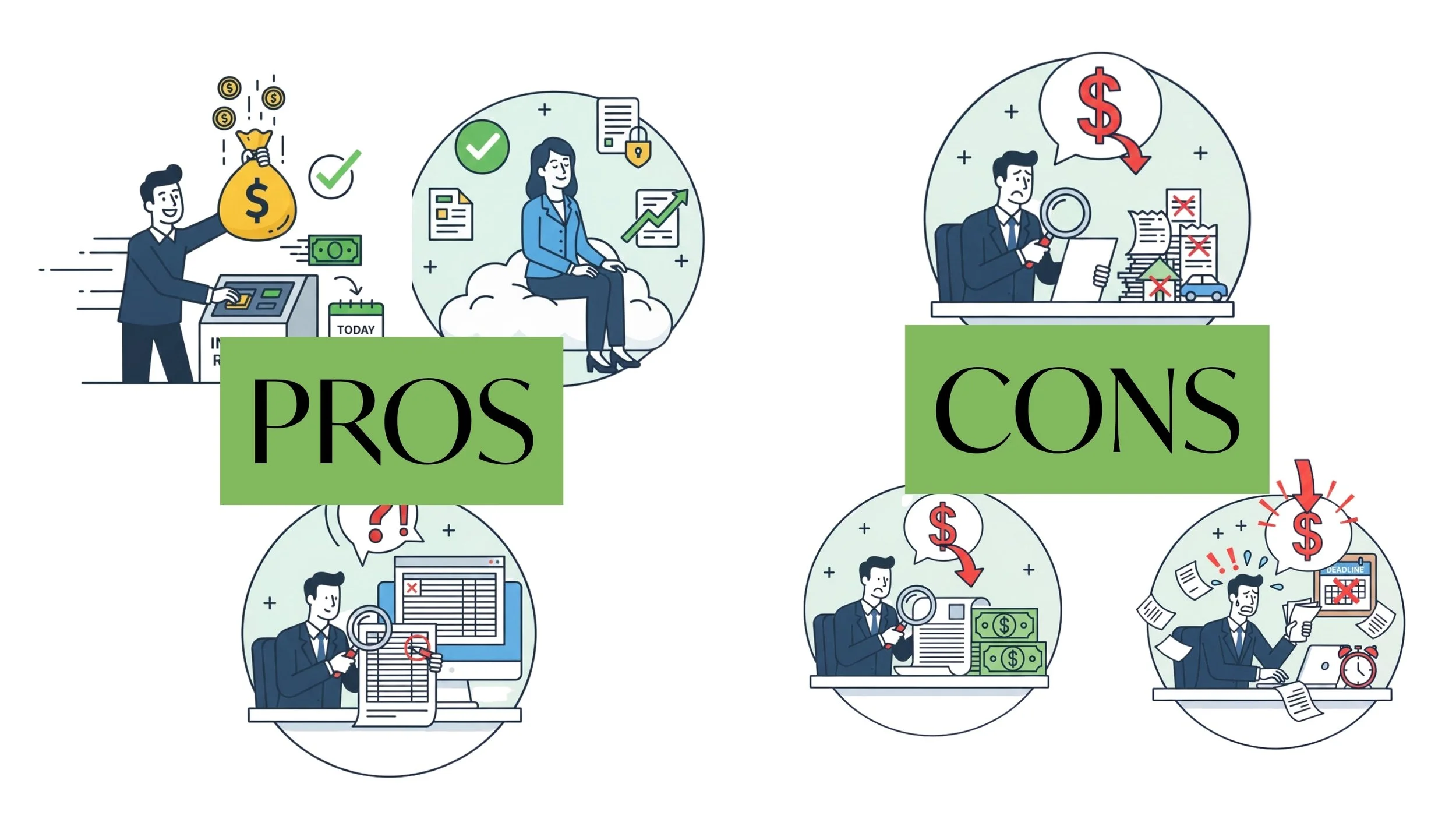
Bottom line: File early if expecting a refund and records are complete; wait if maximizing deductions. For 2025, aim for February/March if possible.
Strategies for Small Business Tax Planning and Minimizing Liability
Tax planning isn't a once-a-year chore—it's year-round optimization. Smart tax planning services can help you legally reduce your liability while staying compliant.
Core Strategies
Timing Income/Expenses: Defer revenue or accelerate deductions to lower brackets.
Leverage Structure: Sole prop? Simple but personal liability. LLC/S-Corp? Pass-through savings.
Maximize Credits/Deductions: Beyond basics, explore QBI (20% off qualified income) or employee retention credits.
Retirement Investments: Contribute to SEP-IRAs for immediate deductions.
Loss Management: Carry forward net operating losses (NOLs) to offset up to 80% of future income.
Protecting Personal Taxes from Business Losses
Losses can offset personal income, but excess may trigger limits. A trusted small business accountant can help structure your business to minimize personal exposure.
When and Why to Hire Business Tax Services

DIY taxes work for simple setups, but professionals shine when things get complex. Working with a firm that offers comprehensive accounting and tax services can save you thousands and countless hours.
Benefits of outsourcing your business tax services:
Expertise from CPAs and Enrolled Agents who spot overlooked savings
Full audit support and representation
Year-round strategic planning (not just last-minute filing)
Peace of mind knowing everything is accurate and optimized
Many owners discover the benefits of hiring a small business tax consultant far outweigh the cost often paying for itself through reduced liability and avoided penalties.
When and Why to Hire Business Tax Services
DIY taxes work for simple setups, but pros shine for complexity. Benefits:
Expertise: CPAs/Enrolled Agents spot overlooked savings (average 15% liability cut).
Compliance: Handles audits, extensions; avoids $10K+ penalties.
Time Savings: Outsource for focus on revenue.
Planning: Year-round advice on structures, like LLC vs. S-Corp.
Choosing a Provider
Credentials: CPA/EA certified.
Experience: Matches your industry/size.
Cost: $500-$3,000 avg. for small biz; compare quotes.
Services: Prep, planning, compliance bundle.
For 2025, outsource if revenue >$100K or multi-state. Providers like TotTax offer tailored business tax services.
Keeping Organized: Tools and Habits for Tax Success
Organization = savings. Tips:
Filing System: Categories (e.g., "2025 Expenses") in Google Drive/Dropbox.
Digital Tools: Expensify for receipts; FreshBooks for invoicing.
Quarterly Reviews: Reconcile books; adjust estimates.
Hire Help: Bookkeeper for $20-50/hr if overwhelmed.
Avoid pitfalls: Procrastination (adds errors), unchecked software (garbage in, garbage out), ignored updates (2025 law changes).
Wrap-Up: Take Control of Your Taxes Today
Taxes don't have to derail your small business dreams. By mastering brackets, deductions, deadlines, and strategies, you'll not only comply but thrive—potentially saving thousands. Start now: Review records, model scenarios, and consider partnering with experienced business tax services in Denver or nationwide.
Ready for personalized help? Explore professional tax planning services or connect with a dedicated Denver small business accountant. Here's to a prosperous, tax-smart 2025!
Frequently Asked Questions
-
For pass-through businesses (sole proprietors, LLCs, S-corps), 2025 federal tax brackets range from 10% on the first $11,925 of taxable income (single filer) up to 37% on income over $626,350. Married filing jointly thresholds are roughly double. Many small businesses also qualify for the 20% Qualified Business Income (QBI) deduction, which can effectively lower your top rate.
-
Key 2025 deadlines: Partnerships and S-corps file by March 17; C-corps and sole proprietors (on personal returns) by April 15; estimated quarterly payments are due April 15, June 16, September 15, and January 15, 2026. Extensions move filing deadlines but not payment deadlines.
-
The most valuable 2025 deductions include Section 179 and bonus depreciation (up to $1.22M immediate expensing), home office expenses, vehicle mileage (67¢ per mile), health insurance premiums (100% for self-employed), retirement contributions (up to 25% of compensation in a SEP-IRA), and the 20% QBI deduction for eligible pass-through entities.
Read more…